News & Views
Transforming Sacred Spaces: How Faith-Based Properties Are Becoming Affordable Housing Solutions
By Geoff Milz, Regional Vice President, Midwest & Patrick Stewart, Regional Vice President, Maryland, D.C., Virginia
Across the country, many parishes, congregations, and faith communities are grappling with a steady decrease in regular attendance and participation. One side effect of this trend is that faith-based organizations with traditionally large property portfolios are increasingly exploring solutions to leverage their real estate assets to better serve their communities.
For example, many are finding meaningful opportunities to address one of the most pressing needs in their neighborhoods: affordable housing.
For faith leaders and community organizations, repurposing surplus land or underutilized buildings aligns with their core mission of service while creating lasting community impact. These properties, often located in established neighborhoods with access to transit and services, are ideal locations for new affordable housing development.
At Pennrose, we've had the privilege of partnering with faith-based organizations, nonprofits, and community groups to help transform former churches and excess space into vibrant affordable housing communities.
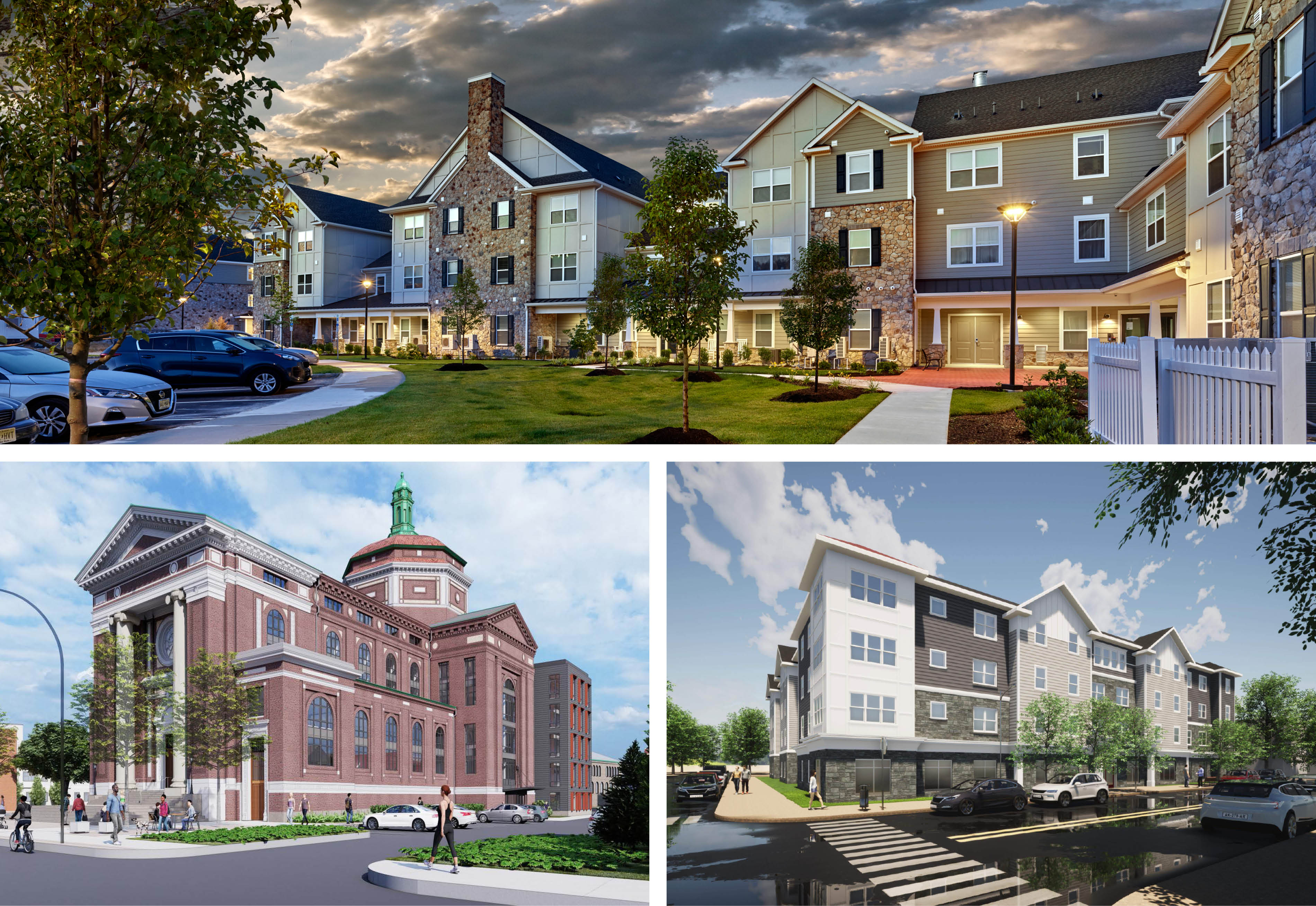
Weinberg Commons I & II
One of our most successful examples is Weinberg Commons I & II in Cherry Hill, New Jersey. Developed in partnership with the Jewish Federation of Southern New Jersey (JFED), who donated the land needed to develop the property, the 160-unit affordable community demonstrates how a shared vision can create lasting impact for individuals and families.
 Completed in 2020, the multi-phase development features 128 apartments for tenants aged 55 and older and 32 units designed specifically to support adults with special needs.
The special needs homes are grouped into eight congregate living facilities, each containing four one-bedroom units with a large shared common space for living, dining, kitchen, laundry, and office space, where socialization and access to services can be provided in a safe and open setting.
The partnership extended well beyond development. JFED also serves as the on-site supportive services provider for Weinberg Commons, offering wrap-around programming including cooking and nutrition programs, financial literacy classes, healthcare, mental and behavioral health services, and more. Free events are held at the property three times per month, and a service coordinator connects with residents to ensure they have appropriate linkages to area resources.
Blessed Sacrament
This month, we broke ground on the Blessed Sacrament redevelopment in Boston's Jamaica Plain neighborhood. This adaptive reuse will transform a vacant 1913 historic church into a vibrant mixed-use, mixed-income community featuring 55 affordable apartments and space for youth arts and culture programs.
 Working with architect DiMella Shaffer and partner Hyde Square Task Force, we're preserving the building's historic façade and adapting the church's main nave into a 200+ capacity multipurpose community space. The building's cupola will be repurposed as a community room for residents.
The apartments, ranging from studios to two-bedrooms, will serve households earning between 30% and 80% of Area Median Income, with six units set aside for formerly homeless residents. Expected to be completed in winter 2027, the revitalized 71,000-square-foot site will anchor the Latin Quarter and help spur continued investment on Centre Street.
These projects represent just a few examples of innovative, solution-oriented partnerships across our footprint. In Glenarden, Maryland, we partnered with SHABACH! Ministries, Inc. to transform a 27-acre property into 424 mixed-income homes at Glenarden Hills. Pointe View at Aspen Hill, also in Maryland, was developed on surplus land owned by Wheaton Seventh-Day Adventist Church, creating 120 affordable, amenity-rich apartments for seniors. In Atlanta, Haven at South Atlanta was developed with Focused Community Strategies, a faith-based 501c(3), while Good Shepherd Senior in Philadelphia was built on land provided by Good Shepherd Presbyterian Church.
What makes these partnerships successful is a shared commitment to community impact. Faith-based organizations have long been anchors in their neighborhoods, and repurposing property for affordable housing allows them to continue their mission of service in a new form. These projects demonstrate how creative collaboration can transform underutilized assets into much-needed housing while honoring a legacy of service.